Weight Loss Meal Plan: A Simple Guide That Fits Your Week
By:Author:no.Diet Editorial
Updated on:October 18, 2026

- Does a Weight Loss Meal Plan Actually Work?
- Structured Meal Plan or Calorie Counting Alone: Which Wins
- Why a Ready-Made Plan Beats Starting From Zero Daily
- Adapting a Weight Loss Meal Plan to Your Situation
- Fitting a Meal Plan Into a Normal Week
- The Myth That One Meal Plan Melts Fat Fast
- Building Your Weight Loss Meal Plan With No.Diet
- Making Your Meal Plan a Permanent Routine
A weight loss meal plan is a structure for eating fewer calories than you burn, built from food you can actually keep eating. It works through a calorie deficit, not through any single ingredient or forbidden food list.
The mechanism is plain arithmetic: eat less energy than your body uses and your body draws on stored energy to cover the gap. A plan just makes that gap easier to hold day after day instead of relying on willpower alone.
This article covers how a meal plan actually works, how it compares with cutting calories without structure, who it suits, and how to fit one into a week that's already full.
Does a Weight Loss Meal Plan Actually Work?
A meal plan works the same way any deficit works: it sets out what and roughly how much you'll eat so you're not deciding from scratch three times a day.
Decision fatigue is real in a practical sense - when every meal is an open question, it's easy to default to whatever's fastest, which isn't always the lowest-calorie option.

The Arithmetic Behind It
If a plan sets you at a few hundred calories below what you burn in a day, that gap adds up over a week into a deficit measured in thousands of calories, which is where change comes from.
No single food creates that gap on its own - portion sizes and total daily intake do the work, and a plan simply lays that out in advance so you're not guessing.
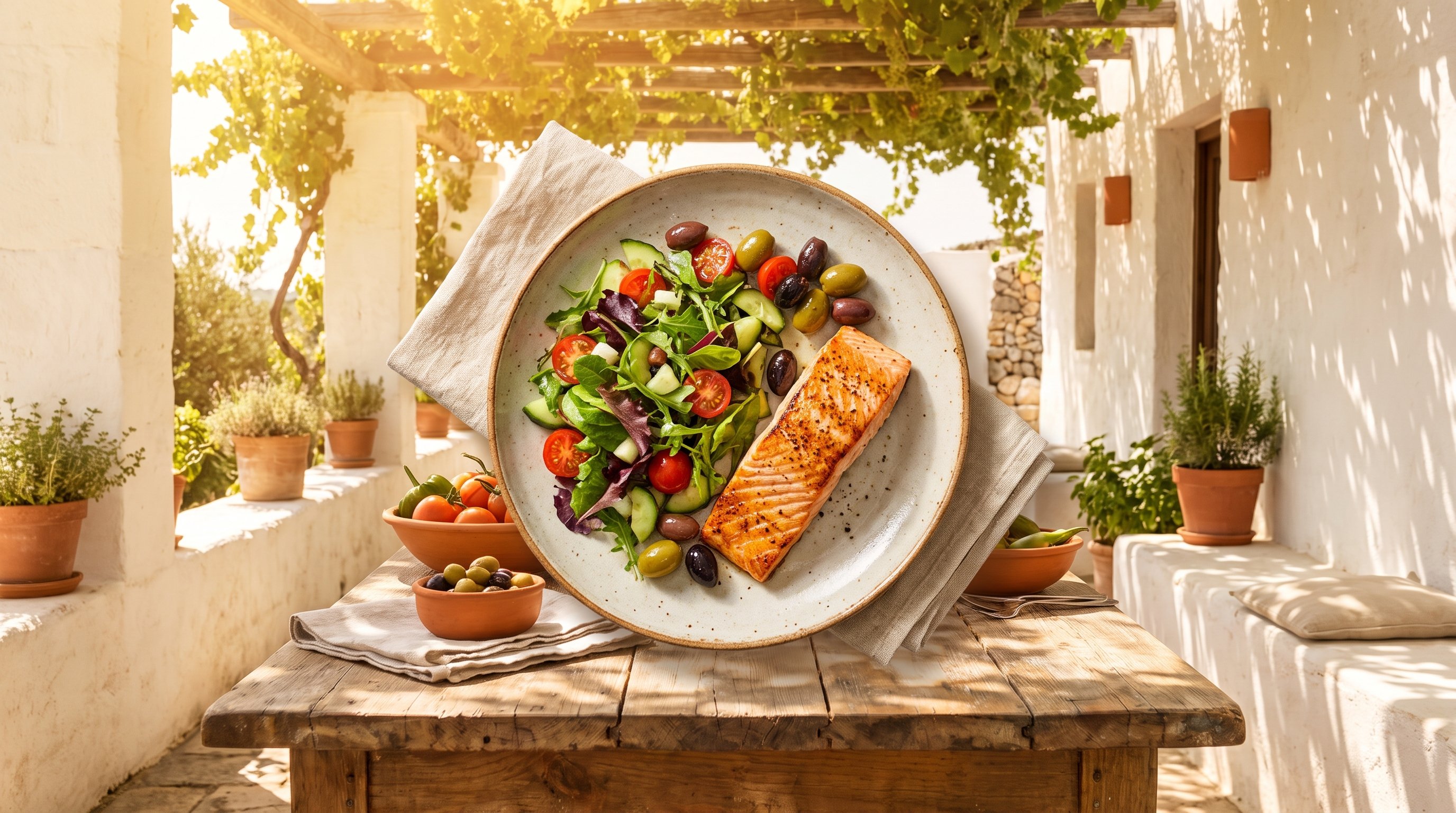
A plan built around Mediterranean-style meals - vegetables, whole grains, legumes, fish, olive oil - tends to be easier to hold at a deficit because those foods are filling for their calorie cost.
Structured Meal Plan or Calorie Counting Alone: Which Wins
Both approaches can create a deficit. The difference is in how much daily decision-making each one demands and how long people tend to stay with it.

A structured plan tells you what to eat; counting alone only tells you the number you're aiming for and leaves the choosing up to you, meal by meal.
| Factor | Structured Plan | Counting Alone |
|---|---|---|
| Daily decisions | Mostly pre-set | Made fresh each meal |
| Flexibility | Lower, more guidance | Higher, more guesswork |
| Learning curve | Follow the structure | Requires tracking skill |
| Good for | Busy, decision-fatigued weeks | People who like detail |
| Risk of drift | Lower once routine sets | Higher without logging |
Why a Ready-Made Plan Beats Starting From Zero Daily
Starting from zero every day means weighing up every option against your calorie target before you've even eaten breakfast.
A plan removes most of that weighing-up. You already know roughly what's on the plate, so the only decision left is whether to follow it today, which is a much smaller ask.
That's the real adherence argument: not that one method burns more, but that one method asks less of you on a tired Tuesday, and tired Tuesdays are most of the week.
Adapting a Weight Loss Meal Plan to Your Situation
If You're Just Starting Out
Keep the plan simple for the first couple of weeks - a handful of repeatable meals beats a long rotating menu you'll never fully use.
If Your Week Is Packed
Lean on meals that reuse the same base ingredients so prep time stays low even when the plan looks varied on paper.
If You're Older or Managing Joint Issues
A meal plan pairs naturally with light movement rather than intense exercise, since the deficit is doing the work, not the workout.
If You've Tried Diets Before and Stalled
Pick a plan built on substitution - swapping like for like - rather than one that bans entire food groups, since restriction is usually what breaks first.
Fitting a Meal Plan Into a Normal Week
A meal plan only earns its place if it survives contact with a real Tuesday - the one with a late meeting, a tired commute and a fridge that's half-empty.
That means built-in flexibility: a couple of swap options per meal, and a shopping list short enough that you'll actually use it.
no.Diet builds its plans around Mediterranean-style meals you're likely to already enjoy, so following the plan feels like eating normally rather than following a separate set of rules.
Keeping the plan, your steps and your water intake in one place also cuts down on the number of things you have to remember to do each day.
The Myth That One Meal Plan Melts Fat Fast
No meal plan targets fat in one place, and none works overnight. The body doesn't let you choose where weight comes off, and it doesn't skip the time it takes to build a deficit.
What actually happens is slower and less dramatic: you eat at a deficit consistently, and change follows at its own pace, which varies from person to person.
The honest answer is that there's no shortcut food or magic combination - just a deficit held over time, which is exactly what a sustainable plan is built to make easier.
Building Your Weight Loss Meal Plan With No.Diet
Once the arithmetic is clear, the next question is simply how to hold the deficit without rebuilding your plate from scratch every single day.
no.Diet gives you a tailored Mediterranean meal plan, light exercises, progress trackers and lifestyle challenges, all built around food you already like rather than a list of things to avoid.
Instead of guessing what to cook tonight, you open a plan that's already mapped out, with exclusive content to keep the routine interesting as weeks go by.

Healthy Eating Simplified
Build Better eating Habits
Making Your Meal Plan a Permanent Routine
The best weight loss meal plan is the one you're still following in a month, not the one that looks most impressive on day one.
Pick a small, repeatable set of meals, track progress somewhere simple, and let no.Diet handle the planning side so your energy goes into just showing up.
FAQ
That depends on the size of the deficit and how consistently you hold it, so there's no fixed figure that applies to everyone. What matters more is whether the plan is one you can keep following for more than a few weeks.
Not if it's built on substitution rather than elimination - swapping a higher-calorie option for a filling, lower-calorie one instead of cutting out entire food groups. A plan built around food you already enjoy tends to feel like eating well, not eating less of everything.
Look for a plan built around meals that share ingredients and take little active prep, since time is usually the real barrier, not willingness. Simplifying the plan itself solves this faster than trying to find more hours in the day.
Plans that are too rigid or too far from someone's normal tastes tend to get abandoned first, often within the first couple of weeks. no.Diet is built around Mediterranean-style meals and light habits specifically to lower that drop-off point.
Share this post